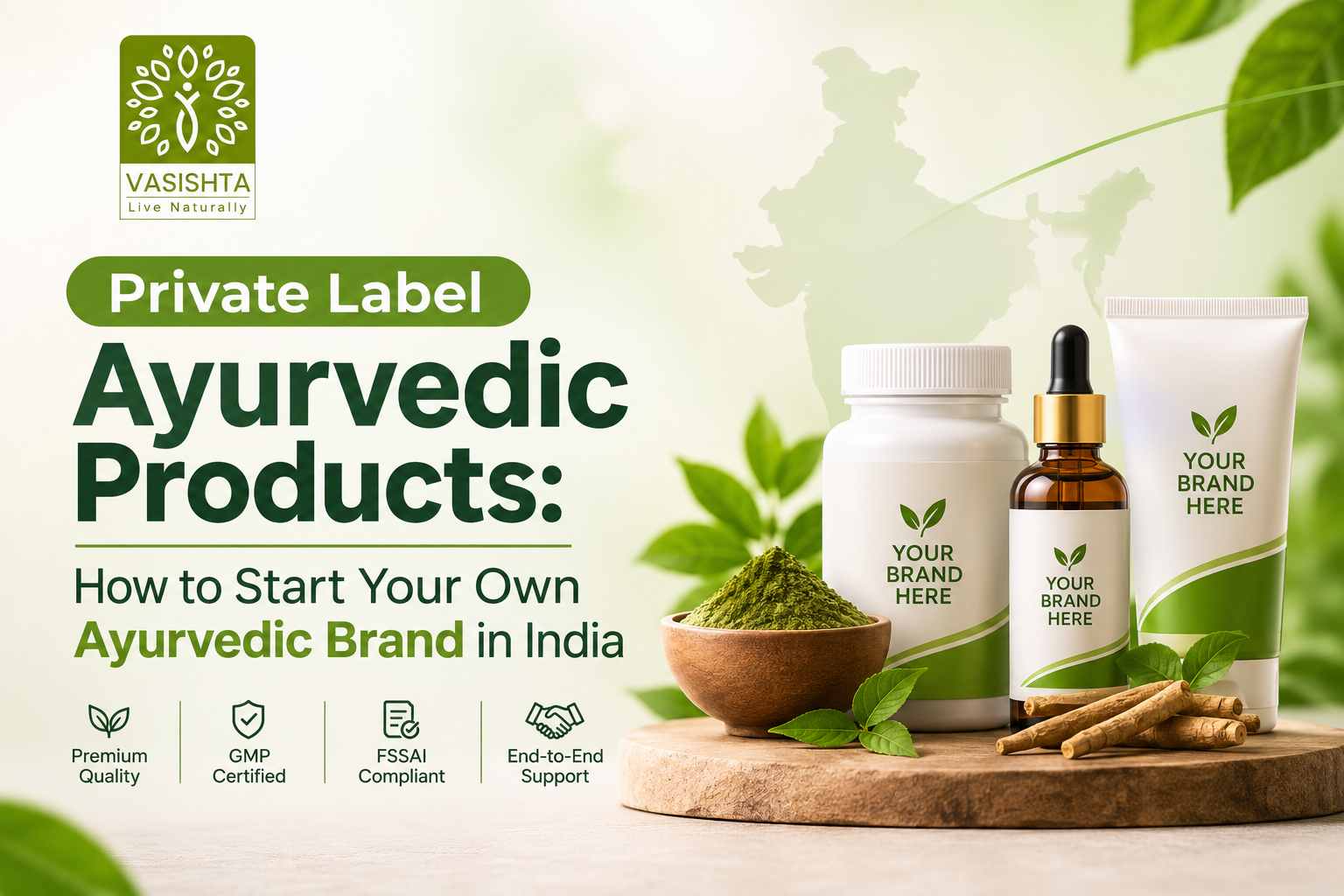
Quick answer: Private label Ayurvedic products are Ayurvedic or herbal products made by a licensed manufacturer and sold under your own brand name. The manufacturer looks after the formula, production, testing and packing. You look after the brand, pricing, marketing and sales. It is the simplest way to start an Ayurvedic brand in India without building your own factory.
Maybe you are a yoga teacher whose students keep asking which hair oil you use. Maybe you run a pharmacy, a wellness clinic or an online store, and you want products with your own name on them. Either way, the same question comes up: how do you get quality Ayurvedic products made without spending crores on a factory, machines and licences?
That is exactly the problem private labelling solves. This guide walks you through how it works, the choices you will face, the rules for labels and licences, what affects cost and time, and the mistakes worth avoiding. There is a short quiz and a launch checklist along the way, so you can work out your own next step as you read.
Key takeaways
- With private labelling, a licensed manufacturer makes the product and your brand sells it.
- You can choose white label (fastest), private label with a ready formula, or a custom formula (most unique, slowest).
- Your product category (Ayurvedic medicine, food supplement or cosmetic) decides which licences and label rules apply.
- Labels on Ayurvedic medicines must follow Rule 161 of the Drugs and Cosmetics Rules, 1945.
- Most successful brands start with two or three products, learn from real sales, then expand.
What are private label Ayurvedic products?
A private label Ayurvedic product is made in a licensed manufacturing unit and packed in your bottle, jar or box, with your brand name and design. On the pack, the manufacturer is usually shown as the maker (“Manufactured by”) and your company as the brand owner (“Marketed by”).
Think of it like a restaurant that uses a trusted central kitchen. The kitchen has the equipment, the trained staff and the hygiene approvals. The restaurant owns the menu, the name and the customer experience. In the same way, the manufacturer brings a GMP-certified facility, raw-material testing and production know-how, while you bring the brand and the customers.
Popular product types for private labelling include herbal hair oils, face creams and face packs, churnas (powders), capsules and tablets, syrups and tonics, massage oils and gels, and granules for children’s nutrition.
Private label vs white label vs custom formulation: what is the difference?
People often use these terms loosely, which causes confusion when you compare quotes. Here is how they differ in practice.
| Model | What you get | Exclusive to you? | Speed to market | Best for |
|---|---|---|---|---|
| White label | A ready product the manufacturer already supplies to several brands, with your label added | No | Fastest | Testing a market on a small budget |
| Private label (ready formula) | A tested formula from the manufacturer’s range, in your chosen packaging and design | Sometimes, if agreed in writing | Fast | Most first-time brands |
| Custom formulation | A new formula developed with the manufacturer’s R&D team for your brand | Yes, if ownership is agreed | Slower | Brands that want a unique product |
| Third party (contract) manufacturing | The manufacturer produces a formula you already own, to your specification | Yes | Depends on approvals | Established brands scaling up |
The short version: private labelling means putting your brand on a manufacturer’s proven formula, while third party manufacturing means getting your own formula made. Many manufacturers offer both, so you can start with one and move to the other as you grow.
How does a private label Ayurvedic product go from idea to shelf?
Most launches follow the same seven steps. The infographic below shows the whole journey at a glance.
Pick a niche
Choose one clear customer group, such as hair care for young women or daily wellness for busy professionals, and shortlist 2 to 3 hero products.
Choose the formula
Decide between a ready formula from the manufacturer’s range and a custom one. Ask for the ingredient list and test reports.
Protect your brand name
Check the name is free to use, apply for a trademark, and confirm it can be approved for your product category.
Design label and packaging
Pick bottles, jars or boxes, then design artwork that carries every legally required detail.
Approve samples
Check colour, smell, texture and packing quality. Ask a few loyal customers for honest feedback.
Production and quality checks
Your batch is made, tested and packed. Ask for the batch’s certificate of analysis before dispatch.
Launch, learn, reorder
Sell through your website, marketplaces or stores, track what customers buy again, and plan your next batch.
Steps 3 and 4 cause most delays. Starting your trademark search and label design early, while samples are being prepared, can save you weeks.
Quick quiz: which route suits your brand?
Answer four questions to see whether a ready formula, a custom formula or contract manufacturing fits you best.
1. Do you already own a tested formula?
2. How soon do you want your first product on sale?
3. What matters more right now?
4. What is your budget for the first batch?
This quiz gives a general direction only. A good manufacturer will discuss your goals before recommending a route.
What licences do you need to sell private label Ayurvedic products?
The first question is not “which licence?” but “what exactly is my product?” In India, the same herbs can fall under different rules depending on how the product is classified:
- Ayurvedic medicines (classical or proprietary) are regulated under the Drugs and Cosmetics Act, 1940 and the Drugs and Cosmetics Rules, 1945, with the Ministry of Ayush setting policy. Manufacturing licences are issued by the State Licensing Authority.
- Health supplements and nutraceuticals, such as some herbal capsules, powders and drinks, are generally regulated by FSSAI as food products.
- Herbal personal care items, such as some soaps, face washes and shampoos, may follow cosmetic rules instead.
In most private label arrangements, the product is made under the manufacturer’s licence, and your brand name is approved for that product. Your company appears on the label as the marketer, so you do not need your own manufacturing licence or factory.
A loan licence is a different route. Under Form 25-E, a brand owner holds their own licence to have products made at another licensed unit. It gives more control but also more paperwork and responsibility, so it usually suits brands that are already established.
Whichever route you choose, you will usually also need business and GST registration, a trademark for your brand, and any documents your sales channels ask for, such as marketplace seller paperwork. Rules are updated from time to time, so confirm current requirements with your manufacturer and the state authority before you launch.
What must an Ayurvedic product label show?
For Ayurvedic medicines, labelling is governed by Rule 161 of the Drugs and Cosmetics Rules, 1945. A good manufacturer will check your artwork against these rules, but it helps to know the basics yourself.
Two recent points are worth knowing. First, amendments notified in 2026 allow label information to also be shown through a QR code, GTIN or barcode, which helps on small packs. Second, products containing ingredients listed in Schedule E(1) need special caution wording, and online platforms can sell them only against a valid prescription.
Just as important is what you should not print. Claims that a product cures or treats a disease can break advertising laws such as the Drugs and Magic Remedies (Objectionable Advertisements) Act, 1954, and they damage customer trust. Describe ingredients, traditional use and directions honestly instead.
How much does private labelling cost, and how long does it take?
There is no single price list, because every product is different. These are the factors that move the cost the most:
- Product format: oils and powders are usually simpler to produce than tablets or capsules.
- Ingredients: rare or premium herbs and extracts cost more.
- Packaging: custom bottles, printed cartons and special caps add cost and lead time.
- Batch size: larger batches lower the cost per unit but tie up more cash.
- Custom work: new formulas need development, sample rounds and stability testing.
Timelines follow the same logic. The chart below compares the three main routes.
Tip: ask for quotes at two or three batch sizes. Seeing how the unit cost changes helps you choose a first order that fits your budget without leaving you short of stock.
Case study: from a yoga studio to a three-product brand
This example is based on a common journey for first-time brand owners. The name and details are illustrative, not a specific client.
The situation
Meera runs a yoga studio in Bengaluru with around 200 regular students. They often asked which herbal oil and wellness products she used. She wanted to offer her own range, but she had no manufacturing experience and a limited budget.
What she did
- Chose one niche: simple daily self-care for busy professionals.
- Picked three ready formulas from a manufacturer’s range: a herbal hair oil, an ashwagandha capsule and a herbal face pack.
- Visited the manufacturing unit in Bengaluru to see the facility and try the samples.
- Used the manufacturer’s design team for labels, and applied for a trademark on her brand name.
- Ordered a small first batch and sold it at the studio and through a simple online store.
What happened
The hair oil sold out first and brought the most repeat orders. The face pack sold slowly, so she did not reorder it. With real sales data in hand, she went back to the manufacturer to develop a custom version of the hair oil with a fragrance unique to her brand.
Lessons
- Start narrow. Three products were enough to learn what her customers really wanted.
- Seeing the facility in person built confidence and saved weeks of back-and-forth.
- Custom formulation made more sense after the market had proved demand.
What mistakes do first-time brand owners make?
- Launching too many products at once. Ten products split your budget and attention. Two or three strong ones are easier to market.
- Choosing on price alone. The cheapest quote can mean weaker testing or inconsistent batches. Compare certifications, test reports and how quickly the team replies.
- Making health claims. Words like “cures” or “guaranteed results” can lead to legal trouble and lost trust.
- Leaving the trademark too late. Printing labels before checking your name can mean reprinting everything.
- Not agreeing on ownership. If a formula is developed for you, put in writing who owns it and whether it is exclusive.
- Ignoring repeat orders. Your first batch is a test. Track which products customers buy again before you scale up.
Your private label launch checklist
Tick off each step as you go. Your progress is saved in this browser, so you can come back to it later.
Why work with a manufacturer close to you?
Being able to visit the unit, check samples in person and talk to the team face to face makes a real difference, especially for a first launch. For brands in Karnataka, Tamil Nadu, Kerala, Andhra Pradesh and Telangana, a Bengaluru-based manufacturer also means shorter transit times and simpler logistics.
At Vasishta Pharmaceuticals in Bengaluru, we work with new and growing brands as an Ayurvedic private label manufacturer. Our range includes 50+ FSSAI-approved, ISO-certified products across hair and skin care, joint care, immunity, women’s care, kids’ nutrition and more. An in-house R&D team supports custom formulation, and our design team helps with labels and packaging. If you already have your own formula, visit our Ayurvedic third party manufacturer in Bangalore page, or browse our product range to see formulas available for private labelling.
Frequently asked questions
What is private labelling of Ayurvedic products?
Private labelling is an arrangement where a licensed Ayurvedic manufacturer makes a product and packs it under your brand name and label. The manufacturer handles formulation, production and quality testing. Your company is shown as the marketer and looks after branding, pricing and sales.
What is the difference between third party manufacturing and private labelling?
In private labelling, you usually choose from the manufacturer's existing, tested formulas and add your brand. In third party (contract) manufacturing, the manufacturer produces a formula you own or have developed, made to your specification. Private labelling is faster to launch; third party manufacturing gives you more control.
What are white label Ayurvedic products?
White label Ayurvedic products are ready-made products that a manufacturer supplies to several brands, with only the label changed. They are the quickest and cheapest way to start, but other brands may sell an identical product, so you compete on branding, price and service.
Can I launch with a ready formulation under my own brand name?
Yes. Most new brands start this way. The formula, test data and licence work often already exist, so you mainly need to approve your brand name, label and packaging. Ask whether the formula will be exclusive to you or shared with other brands.
Can a manufacturer develop a fully customised formula for my brand?
Yes, if the manufacturer has an in-house R&D team. Expect sample rounds, stability testing and licence approval for the new product, which take longer and cost more than a ready formula. Agree in writing who owns the formula.
What is the minimum order quantity for private label Ayurvedic products?
It depends on the manufacturer, the product format and the packaging. Ready formulas in standard packs usually have lower minimums than custom formulas or special packaging. Ask for quotes at two or three batch sizes to see how the unit cost changes.
Who designs the label and packaging?
Either you or the manufacturer. Many manufacturers have an in-house design team that creates artwork and checks that the label carries every required legal detail. Even if you use your own designer, ask the manufacturer to review the final artwork before printing.
What must be printed on an Ayurvedic product label?
For Ayurvedic medicines, Rule 161 of the Drugs and Cosmetics Rules, 1945 sets the requirements. Labels typically include the words Ayurvedic Medicine, the product name, ingredients and quantities, licence number, batch number, manufacturing and expiry dates, dosage, and the manufacturer's name and address.
Do I need a licence to sell private label Ayurvedic products?
In most private label arrangements, the product is made under the manufacturer's licence and your company is named as the marketer, so you do not need your own manufacturing licence. You will still usually need business and GST registration, a trademark and any documents your sales channels ask for. Confirm the details with your manufacturer.
How do I start a private label Ayurvedic brand in Bangalore?
Pick a focused niche, shortlist two or three products and visit a Bengaluru-based, GMP-certified manufacturer to review samples and the facility. Then finalise your brand name and label, approve samples, and start with a small first batch you can sell through your website, marketplaces or local stores.
Ready to plan your first private label product?
Share your idea, your target customer and your budget. Our team in Bengaluru will suggest suitable formulas and a realistic plan for your first batch.
Sources and further reading
- Ministry of Ayush, Government of India
- Central Drugs Standard Control Organisation (Drugs and Cosmetics Act, 1940 and Rules, 1945)
- Food Safety and Standards Authority of India
This article is for general information only. It is not legal or medical advice. Regulations change, so confirm current requirements with your manufacturer and the relevant authority before you launch.